
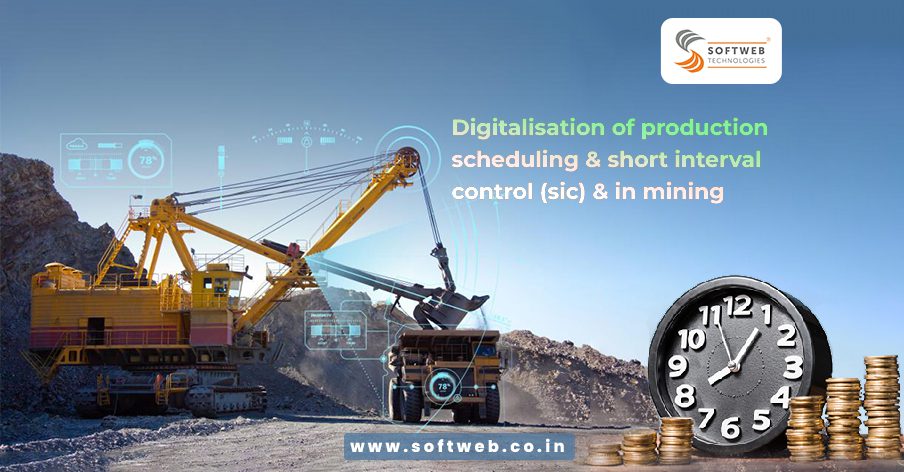
In modern mining, where thousands of interdependent activities run across vast and dynamic environments, scheduling lies at the heart of efficiency and profitability. From drilling and blasting to hauling and processing, every step depends on precise coordination. Yet, in many operations, scheduling still relies on manual inputs and static assumptions — making it difficult to react to changing conditions in real time.
The Challenge: Connecting Plans with Reality
A typical mine receives a weekly production schedule based on medium-term plans. These schedules are then broken down into daily, shift, and hourly activities and production scheduling & short interval control (sic) is planned accordingly. While the process appears straightforward, the real-world execution is complicated.
Unexpected events — such as machine breakdowns, material variations, or weather disruptions — often cause deviations from planned targets. Mine planners and supervisors then need to make quick adjustments with limited visibility of what’s happening on-site.
This disconnect between the tactical plan (what should happen) and the operational plan (what is actually happening) remains one of the biggest challenges in mining today. Ineffective coordination not only reduces productivity but also leads to higher operational costs and wasted resources.
IoT: Bridging the Gap Between Planning and Execution
The Internet of Things (IoT) is redefining how mines plan, monitor, and control their operations. By connecting assets, equipment, and personnel through sensors and data networks, IoT enables a continuous flow of information across all levels of a mining operation.
This real-time connectivity helps transform static schedules into dynamic, data-driven systems that adapt instantly to changing conditions.
Here’s how IoT is bringing intelligence and precision to mine scheduling.
1. Real-Time Visibility and Resource Tracking
IoT sensors placed on drills, trucks, shovels, conveyors, and crushers collect live data on performance, fuel consumption, load, speed, and location. This information is transmitted instantly to the central control system, providing planners with a real-time operational snapshot.
If any deviation occurs — such as an equipment failure or route delay — the system can automatically adjust resource allocation and task assignments. This ensures that production schedules remain relevant and achievable throughout the day.
Platforms like MiningPro, designed for real-time mine monitoring, make this data visible and actionable, allowing planners to make informed decisions backed by live operational insights.
2. Enabling Short Interval Control
IoT plays a key role in production scheduling & Short Interval Control (SIC) — a process of monitoring production performance in frequent intervals (hourly or per shift). By using IoT-based feedback systems, mine operators can:
- Track progress against targets continuously
- Identify bottlenecks or underperforming equipment instantly
- Take immediate corrective action to stay aligned with production goals
This short-cycle monitoring converts data into actionable insights and reduces the lag between issue detection and resolution.
When integrated into intelligent mine platforms like MiningPro, Short Interval Control allows supervisors to analyze performance data visually and implement real-time corrective measures within the same shift.
3. Integration of IT and OT Systems
One of the most significant advantages of IoT in mining is the integration of Information Technology (IT) and Operational Technology (OT). IT systems handle planning, reporting, and analytics, while OT systems control on-site machinery and sensors.
IoT acts as the bridge connecting these two domains. Through this integration, live operational data flows seamlessly into planning and decision-making tools, allowing mines to synchronize plans with execution in real time.
MiningPro facilitates this IT-OT integration by consolidating production data, equipment telemetry, and scheduling updates into one unified digital environment — improving transparency and coordination across departments.
4. Closed-Loop Scheduling and Continuous Optimization
IoT-based systems make closed-loop scheduling possible — where production plans are continuously updated based on live feedback from the field.
Instead of waiting for end-of-shift reports, planners can instantly view deviations, reschedule equipment, or modify production targets based on real-time data. The system automatically recalculates the optimal schedule considering equipment availability, cycle times, and environmental factors enhancing production scheduling & short interval control (sic).
MiningPro enables this closed-loop approach by connecting operational dashboards, predictive analytics, and scheduling tools into a single control framework — ensuring continuous optimisation of mine performance.
5. Predictive and Preventive Maintenance Integration
IoT doesn’t just improve scheduling — it enhances reliability. By analyzing sensor data from machines, predictive algorithms can forecast potential failures and alert maintenance teams in advance.
This proactive maintenance strategy helps planners incorporate service windows into production schedules without disrupting workflow. As a result, mines can minimize unplanned downtime and increase equipment availability.
With MiningPro’s predictive maintenance module, these alerts can be directly linked to scheduling data, ensuring maintenance events are planned with minimal impact on production.
6. Building the Framework for the Digital Mine
The integration of IoT into scheduling and operations lays the foundation for the digital mine of the future. When combined with analytics, AI, and automation, IoT transforms mine scheduling into a smart, self-optimizing system capable of:
- Adapting instantly to changing ground realities
- Reducing idle time and operational delays
- Maximizing equipment utilization and throughput
- Supporting sustainable, data-driven decision-making
This transformation marks a shift from reactive management to proactive, intelligence-based mining operations, where platforms like MiningPro act as the digital command center of the modern mine.
Key Features and Benefits of Short Interval Control (SIC)
1. Shift Schedule Management
Short Interval Control enables the creation or import of detailed shift plans covering each piece of equipment and activity. These plans are accessible across the control room, onboard devices, and mobile applications used by shift supervisors and operators. Having a centralised plan allows the system to continuously monitor performance and compliance with operational targets, forming the foundation of effective shift management.
2. Real-Time Monitoring and Control
SIC provides real-time visibility into equipment status, workforce locations, production performance, and safety indicators. This enables supervisors to closely track operational progress and make instant adjustments to maintain productivity and safety standards throughout the shift.
3. Deviation Tracking During Operations
By continuously analyzing live data, the system automatically detects and flags deviations from the set parameters. These may include delays in task initiation, progress gaps between expected and actual targets, or incorrect material routing. Automated alerts help the control room identify and address issues quickly, minimizing performance losses and improving operational responsiveness.
4. Optimized Production Processes
Real-time analysis of production data allows SIC to identify inefficiencies and bottlenecks within the workflow. This leads to improved resource allocation, reduced downtime, and higher production output through better coordination and scheduling accuracy.
5. Enhanced Safety Management
Safety remains a core function of SIC. The system monitors activities to detect potential hazards such as personnel entering restricted zones, equipment anomalies, or unsafe operating conditions. Instant alerts ensure that corrective measures are taken promptly, helping prevent accidents and maintain a safe work environment.
6. Data-Driven Decision-Making
Comprehensive analytical reports and live dashboards give mine managers the insights they need for informed decision-making. This improves production planning, resource utilization, and overall operational efficiency, resulting in more consistent profitability.
7. Customization and Scalability
SIC solutions are highly flexible and can be tailored to meet the specific needs of both small underground mines and large open-pit operations. The system’s architecture supports easy scalability, adapting seamlessly as the mining operation expands.
Implementation and Integration
SIC combines IoT-enabled hardware for equipment tracking with intelligent software for data visualization and reporting. It integrates smoothly with existing mine management and ERP systems, ensuring unified data flow and interoperability across the operation.
Manual scheduling and fragmented communication can no longer meet the demands of modern mining operations. IoT technology enables real-time visibility, fast decision-making, and adaptive planning — all essential for achieving consistent productivity and cost control.
By connecting machines, systems, and people, IoT closes the long-standing gap between planning and execution.
The result is a mine that operates with greater agility, precision, and profitability — where every schedule is informed by data and every decision drives value.
Solutions like MiningPro make this transformation practical, empowering mines to evolve from paper-based scheduling to a truly connected, intelligent, and data-driven ecosystem.

How a Multi-Unit Tea Blender in Assam Eliminated Blend Traceability Gaps with PACE360 ERP
A leading tea blending company in Assam adopted PACE360 to unify procurement, blending, warehouse management, [...]
Jun

How a Packet Tea Manufacturer in West Bengal Scaled Distribution with PACE360 ERP
See how a leading yarn manufacturer moved beyond traditional procure-to-pay software to CVSS — Softweb’s [...]
Jun
The Future of Coal Supply Chain Management Through Automation & Innovation
See how a leading yarn manufacturer moved beyond traditional procure-to-pay software to CVSS — Softweb’s [...]
Jun

Beyond Procure-to-Pay: How a Leading Yarn Manufacturer Upgraded to CVSS and Cut Procurement Lead Time by 60%
See how a leading yarn manufacturer moved beyond traditional procure-to-pay software to CVSS — Softweb’s [...]
May
Beyond Fleet Tracking: Why Smart Iron Ore Mining Will Shape the Future of India’s Steel Industry
Discover how MiningPro by Softweb Technologies enables smarter, connected, and data-driven smart iron ore mining [...]
May

Blueeye in Kenya: Mara Coffee’s Digital Transformation Strategy for Multi-Farm Workforce Management
Mara Coffee, Kenya is transforming plantation workforce management through digital attendance tracking, productivity monitoring, payroll [...]
May

Why Cement Companies Need Smart Limestone Mining
Understand the nuances of Limestone Mining and How IoT, Fleet management and other Digital Mining [...]
May
Connected Workforce Platform for Open-Cast Mining: A Coal Mine IoT Case Study
Discover how Softweb Technologies deployed a real-time connected workforce IoT platform for open-cast coal mining [...]
May
