
Manufacturing
Agro Plantation
Mining
Retail
Logistics
Healthcare
Education
Travel & Hospitality
Weighbridge Automation & Unmanned Weighbridge Solutions
Weighbridge automation brings intelligence, accuracy, and efficiency to material weighing by eliminating manual errors and operator dependency. With an unmanned weighbridge, trucks can be identified automatically, weighed precisely, and recorded in real time—24/7, without human intervention.
Equipped with RFID, IoT controllers, cameras, and ERP integration, our solution ensures tamper-proof data, faster turnaround, and complete auditability. From raw material receipts to dispatches, every transaction is seamlessly captured into ERP systems like SAP, Oracle, Microsoft Dynamics, and PACE360.
Designed for industries like mining, cement, agriculture, logistics, and construction, our unmanned weighbridge system reduces costs, prevents pilferage, and transforms weighing operations into a transparent, fraud-free process.
How Weighbridge Automation Works
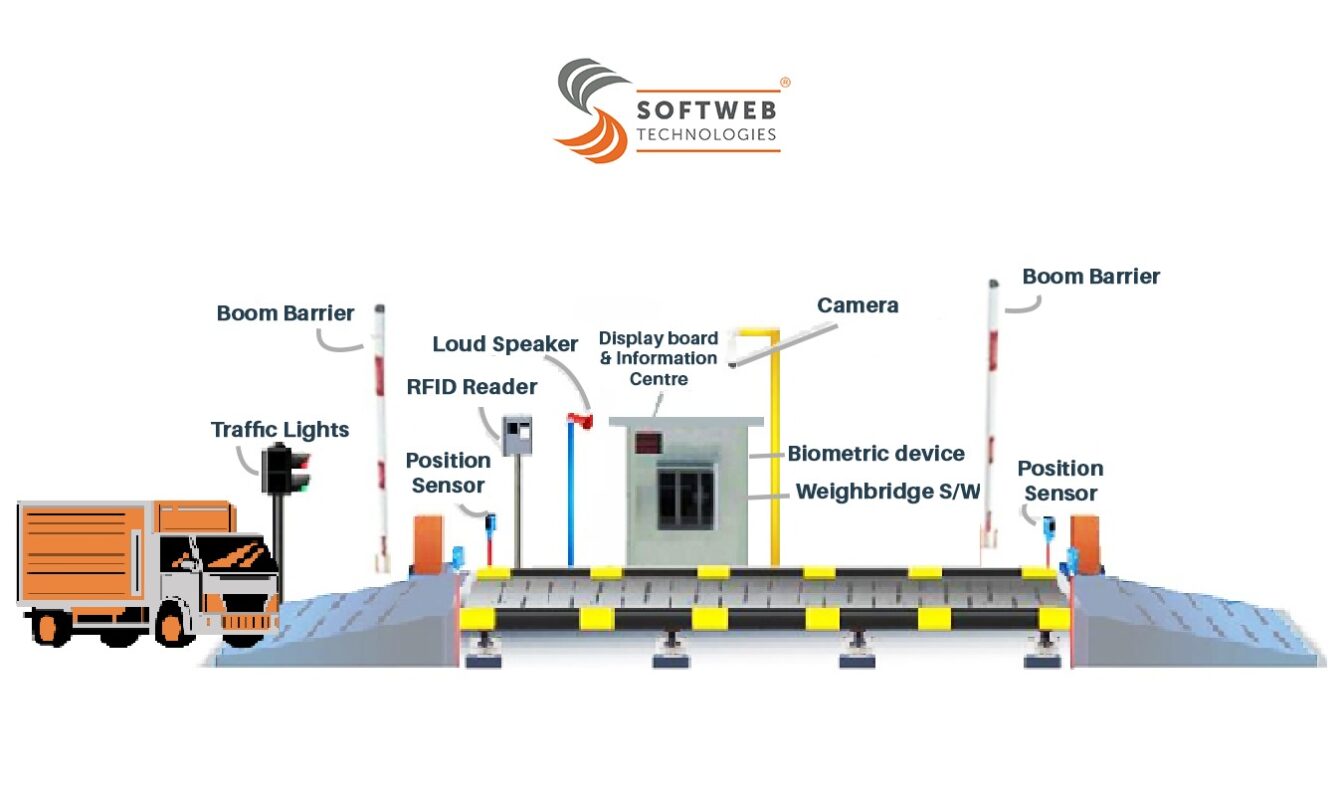
Features of Weighbridge Automation
Benefits of Unmanned Weighbridge Solutions
Accurate Weighment
Smart Weighbridge deliver precise, tamper-proof weight recording, ensuring consistent accuracy across every truckload.
Pilferage Control
Operator-less Weighbridges ensure complete transparency, prevent manipulation, and eliminate pilferage risks, making Weighbridge Automation highly secure for industries worldwide.
Seamless Integration
Unmanned Weighbridge integrates seamlessly with ERP systems like SAP, Oracle, and PACE360, enhancing automation and real-time operational transparency.
Increased Throughput
Weighbridge Automation boosts throughput by enabling faster, 24/7 unmanned weighment operations, optimising capacity utilisation across mining, logistics, and manufacturing industries.
Compliance with Audit & Regulatory Norms
Unmanned Weighbridge ensures compliance with audit requirements and regulatory standards, offering Weighbridge Automation that delivers secure, transparent, and audit-ready weighment data.
Customized Workflows
Weighbridge Automation enables customised workflows tailored for mining, agriculture, logistics, and more, with unmanned weighbridge adaptability for specific industry processes

Operator Independent Truck Dispatch System (OITDS)
- Complete View of Entire Mining Operations
- Productivity Monitoring
- Maintenance Management
- Haulage Road Management & more…

Mine Logistics Monitoring Management
- Vehicle Management
- Multimode Transport
- Route Mapping
- Fleet Management & more…

ERP for Mining Industry Management
- Finance & Accounts
- Payroll management
- Purchase & Sales
- Audit Trail & more…
Frequently Asked Questions
Q1: What is weighbridge automation?
Weighbridge automation uses electronic hardware and software — RFID readers, ANPR and CCTV cameras, positioning sensors, boom barriers, and robotic process automation — to weigh heavy vehicles without manual intervention. It ensures the material delivered matches what’s documented, maintains load compliance, and captures every transaction for reporting, audits, and dispute resolution.
Q2:How does the system verify driver identity on an unmanned weighbridge?
Softweb’s SmartWeigh uses a driver-facing smart kiosk with facial recognition to validate and authenticate each driver before weighment. This ties every transaction to a verified individual, strengthening compliance documentation and closing a common gap in unmanned operations — impersonation or unauthorized drivers at the gate.
Q3: Can SmartWeigh generate challans and e-way bills without manual paperwork?
Yes. RPA bots within SmartWeigh automatically generate and print challans or e-way bills the moment a vehicle completes weighment — no operator has to key in data or trigger the printout. This removes a major bottleneck in semi-automated setups and keeps documentation error-free and instant.
Q4: How are vehicles guided into the correct position on the weighbridge?
SmartWeigh combines IoT-enabled positioning sensors with automated PA voice guidance to direct drivers into the correct spot on the platform in real time. This reduces mispositioned readings, re-weighments, and the need for a staff member to physically direct traffic at the bridge.
Q5: What's the difference between a semi-automated and a fully unmanned weighbridge?
A semi-automated weighbridge still needs staff for select steps — ticket printing, manual vehicle checks, or exception handling. A fully unmanned SmartWeigh setup runs end-to-end: RFID identification, facial recognition-based driver validation, sensor-guided positioning with voice prompts, automated weight capture, RPA-generated challans/e-way bills, and ERP sync — all without a human in the loop.
Our Blog

The Future of Coal Supply Chain Management Through Automation & Innovation
See how a leading yarn manufacturer moved beyond traditional procure-to-pay software to CVSS — Softweb’s [...]
12
Jun
Jun

Beyond Fleet Tracking: Why Smart Iron Ore Mining Will Shape the Future of India’s Steel Industry
Discover how MiningPro by Softweb Technologies enables smarter, connected, and data-driven smart iron ore mining [...]
26
May
May

Why Cement Companies Need Smart Limestone Mining
Understand the nuances of Limestone Mining and How IoT, Fleet management and other Digital Mining [...]
16
May
May
Technology-Driven Strategies to Combat Illegal Mining
Discover how advanced technologies like satellite monitoring, AI, drones, IoT, and digital permit systems are [...]
19
Feb
Feb
ERP Finance with Warehouse Management System: The Difference Between Assumptions and Facts
CFO-focused use cases explaining why ERP Finance with Warehouse Management System minimises inventory risk, working [...]
10
Feb
Feb
ERP Finance & Control Module: CFO Use Cases That Go Beyond Accounting
CFO-focused ERP Finance & Control use cases showing how modern ERP improves cash visibility, margin [...]
09
Feb
Feb
When RFID Fails but BLE Delivers in Real-Time Asset Tracking
RFID vs BLE for real-time asset tracking explained. Learn why RFID fails at scale, how [...]
16
Jan
Jan

Case Study: A Pharma Company’s Digital Journey From Training Delivery to Training Assurance with TORK
Indoco implemented a facial recognition–based training attendance system to validate trainers and trainees in real [...]
16
Dec
Dec
What is weighbridge automation?
Weighbridge automation uses electronic hardware and software — RFID readers, ANPR and CCTV cameras, positioning sensors, boom barriers, and robotic process automation — to weigh heavy vehicles without manual intervention. It ensures the material delivered matches what’s documented, maintains load compliance, and captures every transaction for reporting, audits, and dispute resolution.
How does the system verify driver identity on an unmanned weighbridge?
Softweb’s SmartWeigh uses a driver-facing smart kiosk with facial recognition to validate and authenticate each driver before weighment. This ties every transaction to a verified individual, strengthening compliance documentation and closing a common gap in unmanned operations — impersonation or unauthorised drivers at the gate.
Can SmartWeigh generate challans and e-way bills without manual paperwork?
Yes. RPA bots within SmartWeigh automatically generate and print challans or e-way bills the moment a vehicle completes weighment — no operator has to key in data or trigger the printout. This removes a major bottleneck in semi-automated setups and keeps documentation error-free and instant
How are vehicles guided into the correct position on the weighbridge?
SmartWeigh combines IoT-enabled positioning sensors with automated PA voice guidance to direct drivers into the correct spot on the platform in real time. This reduces mispositioned readings, reweighments, and the need for a staff member to direct traffic at the bridge physically.
What’s the difference between a semi-automated and a fully unmanned weighbridge?
A semi-automated weighbridge still needs staff for select steps — ticket printing, manual vehicle checks, or exception handling. A fully unmanned SmartWeigh setup runs end-to-end: RFID identification, facial recognition-based driver validation, sensor-guided positioning with voice prompts, automated weight capture, RPA-generated challans/e-way bills, and ERP sync — all without a human in the loop.