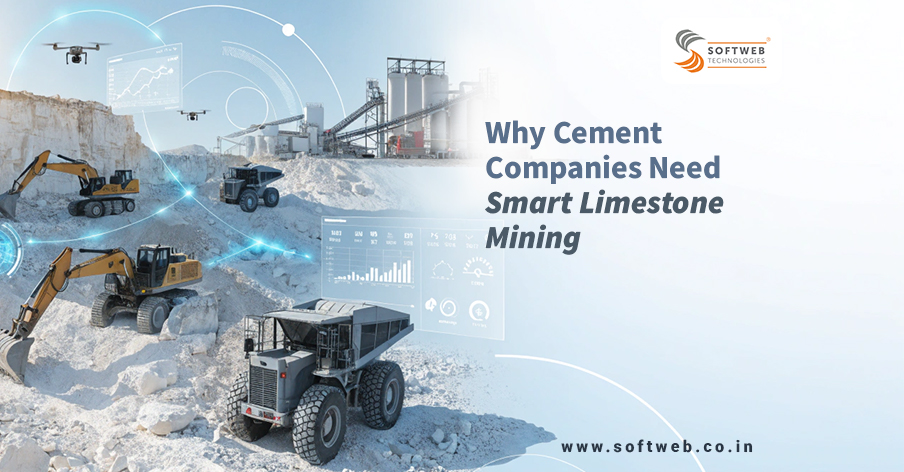
Why Cement Companies Need Smart Limestone Mining

blog-default-img-2

Digital Transformation in Limestone Mining is Becoming a Business Necessity

 
The Indian cement industry is undergoing a significant transformation. Expansion in infrastructure development, urbanisation, highways, industrial corridors, and renewable energy projects is continuously increasing pressure on cement manufacturers to improve production efficiency while maintaining tighter control over operational costs and sustainability goals.
 
Over the last decade, most large cement organisations have invested substantially in modernising their plants through automation, process optimisation, energy-efficient kilns, and advanced quality control systems. However, in many cases, mining operations continue to function with limited digital visibility and fragmented operational monitoring.
 
This gap is becoming increasingly difficult to ignore.
 
For cement manufacturers, limestone mining is not merely a support function. It directly influences plant productivity, crusher availability, fuel consumption, equipment utilisation, maintenance cost, dispatch efficiency, and long-term production planning.
 
As a result, Digital Transformation in Limestone Mining is now emerging as a strategic priority for cement companies aiming to improve operational efficiency and profitability across the value chain.
 
Why Conventional Limestone Mining Operations Face Efficiency Challenges
 
Most limestone mining operations involve complex coordination between:
 
  • Excavators
  • Dumpers
  • Loaders
  • Crushers
  • Haul roads
  • Operators
  • Contractors
  • Dispatch activities
 
In traditional operating environments, much of this coordination still depends on manual supervision, delayed reporting, wireless communication, and spreadsheet-based analysis.
 
While these methods may support basic operations, they often create operational blind spots, such as:
 
  • Inaccurate fleet utilization visibility
  • High equipment idle time
  • Excessive fuel consumption
  • Delayed production reporting
  • Inconsistent crusher feed
  • Poor trip optimisation
  • Unplanned maintenance downtime
  • Limited operational analytics
 
Individually, these inefficiencies may appear manageable. However, across high-volume mining operations running continuously over multiple shifts, the cumulative financial impact becomes substantial.
 
For many cement manufacturers, operational inefficiencies in mining directly affect production cost per ton.
 

The Growing Importance of Digital Limestone Mining

 
Modern mining operations are increasingly adopting connected, data-driven operating models.
 
The objective of Digital Limestone Mining is not only automation, but operational visibility and decision intelligence.
 
Digitally connected mining environments enable organisations to monitor operational activities in real time and make faster, more informed decisions.
 
A digitally integrated limestone mining operation typically enables:
 
  • Real-time fleet tracking
  • Live production monitoring
  • Equipment utilization analysis
  • Operational idle time diagnostics
  • Fuel consumption analytics
  • Predictive maintenance alerts
  • Haulage optimization
  • Centralised monitoring dashboards
  • Automated operational reporting
 
This operational visibility helps management teams identify inefficiencies that are often difficult to detect through manual monitoring systems.


Why Fleet Management in the Limestone Industry is Becoming Critical

 
Loading and hauling operations account for a major portion of mining expenditure in limestone mines.
 
Without proper visibility into fleet movement and utilisation, mining operations often experience:
 
  • Underutilised dumpers
  • Excessive waiting time
  • Improper excavator-dumper allocation
  • Higher fuel wastage
  • Increased cycle time
  • Unbalanced dispatch operations
 
An intelligent Fleet Management in the Limestone Industry helps organisations optimise operational coordination across mining fleets.
 
Advanced fleet management systems typically support:
 
  • GPS-based vehicle tracking
  • Trip monitoring
  • Cycle time analysis
  • Idle time monitoring
  • Fuel efficiency analysis
  • Route optimization
  • Equipment productivity monitoring
  • Shift-wise operational analytics
 
For cement manufacturers operating large mining fleets, even marginal improvements in loading and haulage efficiency can generate significant annual cost savings.
 
Improved fleet visibility also contributes toward:
 
* Better production planning
* Reduced operational delays
* Higher equipment productivity
* Lower operational cost per ton


The Expanding Role of IoT in Limestone Mining

 
The adoption of IoT in Limestone Mining is increasing as mining organisations seek real-time operational intelligence rather than delayed operational reporting.
 
IoT-enabled mining ecosystems allow organisations to continuously capture operational data from equipment and field activities.
 
This includes monitoring of:
 
  • Equipment movement
  • Runtime and idle time
  • Fuel consumption
  • Equipment health parameters
  • Haul road performance
  • Production trends
  • Operational bottlenecks
 
For operations teams, this improves operational control.
 
For management teams, it enables data-driven decision-making supported by measurable field-level insights.
 
Over time, IoT-based monitoring systems also help organisations improve operational benchmarking and long-term planning.


How BLE Beacons & RFID in Limestone Mining Improve Visibility

 
One of the growing trends in smart mining operations is the use of BLE Beacons & RFID in Limestone Mining to improve location visibility and operational traceability.
 
Mining operations involve continuous movement of equipment, manpower, contractors, and materials across large operational zones. Monitoring these movements manually becomes increasingly difficult as the mining scale expands.
 
BLE and RFID technologies help organisations improve operational visibility through:
 
  • Equipment location tracking
  • Vehicle movement monitoring
  • Entry and exit tracking
  • Workforce visibility
  • Dispatch coordination
  • Operational traceability
  • Zone-based monitoring
 
These technologies also reduce dependency on manual operational logging and improve monitoring accuracy across mining operations.
 
For organisations managing multiple mines or large contractor ecosystems, location intelligence is becoming increasingly important for operational discipline and transparency.


Digital Mining and Business ROI

 
For CEOs and business leaders, mining digitisation is increasingly evaluated from a business performance perspective rather than purely as a technology initiative.
 
The financial benefits of digital mining transformation can include:
 
  • Reduced fuel expenditure
  • Improved equipment utilization
  • Lower maintenance cost
  • Reduced operational downtime
  • Better production consistency
  • Higher fleet productivity
  • Reduced operational leakages
  • Improved asset life
 
Equally important is the improvement in operational visibility.
 
Digitally connected mining systems help management teams access accurate operational information faster, improving responsiveness and planning efficiency.


Sustainability and ESG Considerations

 
The cement industry is under growing pressure to improve sustainability performance and reduce operational emissions.
 
Mining operations contribute significantly to fuel consumption and operational carbon footprint.
 
Digital mining systems help organisations improve sustainability metrics by enabling:
 
  • Reduced equipment idling
  • Better haul route optimisation
  • Improved fuel efficiency
  • Lower operational wastage
  • Better asset utilisation
  • Reduced unplanned breakdowns
 
As ESG reporting becomes increasingly important for large industrial organisations, mining operational data will play a larger role in sustainability benchmarking and compliance reporting.


Why Cement Companies Are Prioritising Smart Mining

 
The future competitiveness of cement manufacturers will depend not only on plant efficiency, but also on how intelligently mining operations are managed.
 
Organisations still dependent on fragmented reporting systems and limited operational visibility may face increasing difficulty in maintaining operational efficiency at scale.
 
Smart mining initiatives supported by:
 
  • Digital Transformation in Limestone Mining
  • IoT-enabled operational monitoring
  • Intelligent fleet management systems
  • BLE Beacon & RFID-based tracking
  • Predictive operational analytics
 
are helping cement companies improve operational control, productivity, and long-term cost efficiency.
 
As mining operations become increasingly data-driven, digital visibility will become an essential component of operational excellence in the cement industry.
 
The future of cement manufacturing will not be defined only by plant automation.
 
It will also be shaped by how intelligently limestone mines operate.

    Why Cement Companies Need Smart Limestone Mining

    Discover how Softweb Technologies deployed a real-time connected workforce IoT platform for open-cast coal mining [...]

    Connected Workforce Platform for Open-Cast Mining: A Coal Mine IoT Case Study

    Discover how Softweb Technologies deployed a real-time connected workforce IoT platform for open-cast coal mining [...]

    RPA in Jute Industries: Driving Efficiency in Gunny Bag Supply Operations

    Explore how Robotic Process Automation (RPA) transformed operations in the Jute Industry by automating sales, [...]

    IT/OT Convergence: Types, Benefits, Challenges, and Use Cases

    Learn how IT/OT Convergence connects industrial operations with digital systems using IoT, enabling real-time insights, [...]

    IT/OT Convergence: Connecting the Digital Brain with the Industrial Muscle

    Learn how IT/OT Convergence connects industrial operations with digital systems using IoT, enabling real-time insights, [...]

    Technology-Driven Strategies to Combat Illegal Mining

    Discover how advanced technologies like satellite monitoring, AI, drones, IoT, and digital permit systems are [...]

    ERP Finance with Warehouse Management System: The Difference Between Assumptions and Facts

    CFO-focused use cases explaining why ERP Finance with Warehouse Management System minimises inventory risk, working [...]

    ERP Finance & Control Module: CFO Use Cases That Go Beyond Accounting

    CFO-focused ERP Finance & Control use cases showing how modern ERP improves cash visibility, margin [...]

    Leave a Reply

    Your email address will not be published. Required fields are marked *

    This site uses cookies to offer you a better browsing experience. By browsing this website, you agree to our use of cookies.