
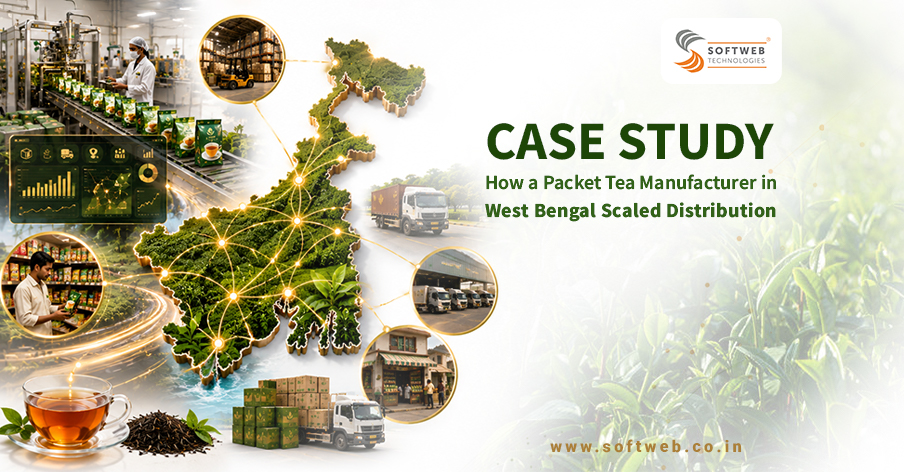
Overview
Client Background
The client is a packet tea manufacturer based in West Bengal with a distribution network spanning multiple districts across Eastern India. Their product range includes 250g, 500g, and 1kg retail packs across multiple blended tea varieties.
The business had grown steadily over several years through a distributor-led model, but operational processes had not kept pace — most coordination between sales, production, and procurement happened informally, with no integrated system tying demand to supply.
The Challenges
1. Demand Forecasting Was Disconnected from Production
Distributor orders arrived without adequate lead time, forcing last-minute procurement of both bulk tea and packaging materials. There was no structured way to aggregate distributor demand signals, translate them into a production plan, and then trigger procurement in time to avoid stockouts or expensive emergency purchases.
2. Packaging Material Tracking Was Manual
Pouches, cartons, laminates, and labels for each SKU were tracked informally. There was no bill-of-materials (BOM) control that automatically deducted packaging inventory when a production order was completed — meaning packaging stockouts were often discovered only when the packing line stopped.
3. Production Wastage Was Unmonitored
Tea loss during packing, packaging material wastage, and SKU-level production variance were not systematically recorded. Without data, it was impossible to identify whether wastage was within acceptable limits or whether there was a recurring process issue on a particular packing line.
4. Distributor Management Was Entirely Offline
Sales order booking, dispatch planning, invoice management, and distributor performance tracking happened through phone calls, WhatsApp messages, and manually maintained Excel sheets. There was no single view of pending orders, dispatched goods, or outstanding distributor bills.
5. Market Returns Had No Formal Process
When distributors returned unsold or damaged stock, the process for recording the return, assessing the condition of the goods, and updating inventory was inconsistent. Some returns were logged; many were not. This created both a revenue leakage problem and an inaccurate finished goods inventory.
PACE360: ERP Solution for Packet Tea Sellers
Production Planning Tied to Demand
SKU-Level BOM and Packaging Material Control
Production Variance and Wastage Monitoring
Distributor and Sales Management
Distributor performance is tracked through SKU-wise and geography-wise sales analytics, making it possible to identify high-performing and underperforming distribution partners and adjust supply allocation accordingly.
Structured Returns Management
Executive Dashboard for Management Visibility
Results at a Glance
|
Metric |
Before PACE360 |
After PACE360 |
|
Demand-to-production lead time |
Reactive; last-minute procurement |
Demand-linked planning with advance lead time |
|
Packaging material stockouts |
Frequent; discovered at packing line |
BOM-controlled; pre-run availability check |
|
Production wastage visibility |
Not tracked |
Variance reports per SKU and per run |
|
Distributor order management |
WhatsApp and Excel only |
Fully digital — orders, dispatch, invoices in system |
|
Returns processing |
Informal; stock not always updated |
Formal returns workflow; inventory always current |
|
Management visibility |
Delayed; no consolidated view |
Real-time executive dashboard with alerts |
Why PACE360
The packet tea selling business has a distinctive operational profile: multiple SKUs with different BOM structures, a distributor network that needs formal order and returns management, and a production function where packaging material control is as important as bulk tea inventory.
PACE360 is designed specifically around these requirements. Unlike generic ERP platforms that require extensive customisation to handle SKU-level BOM deduction or structured returns workflows for FMCG-style distribution, PACE360 delivers these capabilities as standard modules built for the tea industry.

Unmanned Weighbridge System: How RFID, ANPR and Sensors Run the Weighbridge Without an Operator
The modern-day retail stores, post-pandemic, have been facing new challenges in terms of bringing back [...]
Oct
Facial Recognition and AI Video Analytics for Retail Stores: A Practical Guide
The modern-day retail stores, post-pandemic, have been facing new challenges in terms of bringing back [...]
Oct

How a Multi-Unit Tea Blender in Assam Eliminated Blend Traceability Gaps with PACE360 ERP
A leading tea blending company in Assam adopted PACE360 to unify procurement, blending, warehouse management, [...]
Jun
How a Packet Tea Manufacturer in West Bengal Scaled Distribution with PACE360 ERP
See how a leading yarn manufacturer moved beyond traditional procure-to-pay software to CVSS — Softweb’s [...]
Jun

The Future of Coal Supply Chain Management Through Automation & Innovation
See how a leading yarn manufacturer moved beyond traditional procure-to-pay software to CVSS — Softweb’s [...]
Jun
Beyond Procure-to-Pay: How a Leading Yarn Manufacturer Upgraded to CVSS and Cut Procurement Lead Time by 60%
See how a leading yarn manufacturer moved beyond traditional procure-to-pay software to CVSS — Softweb’s [...]
May

Beyond Fleet Tracking: Why Smart Iron Ore Mining Will Shape the Future of India’s Steel Industry
Discover how MiningPro by Softweb Technologies enables smarter, connected, and data-driven smart iron ore mining [...]
May

Blueeye in Kenya: Mara Coffee’s Digital Transformation Strategy for Multi-Farm Workforce Management
Mara Coffee, Kenya is transforming plantation workforce management through digital attendance tracking, productivity monitoring, payroll [...]
May
