

Artificial Intelligence (AI) is no longer a hype but a reality. Across industries, organisations are investing in pilots, deploying tools, and integrating AI into business processes. Yet a paradox persists: while adoption is accelerating, tangible business value remains elusive for the majority. A widening gap is emerging between AI Leaders, who successfully embed AI into workflows, and AI Laggards, who remain stuck in pilot purgatory.
The real differentiator is not access to cutting-edge models—cloud platforms have democratised that—it’s governance, leadership alignment, and the ability to scale AI into everyday decision-making.
Are You Truly Creating Value from AI?
According to the BCG Report, only a small fraction of organisations—around 5%—are truly harnessing AI to drive measurable business impact. These companies can be called “future-ready” because they’ve built the right foundations to make AI deliver innovation, reinvention, and efficiency at scale.
By investing early and strategically, they’re now reaping significant financial and operational gains. Their AI initiatives don’t just automate processes—they transform decision-making, accelerate execution, and unlock breakthroughs that go far beyond routine productivity improvements.
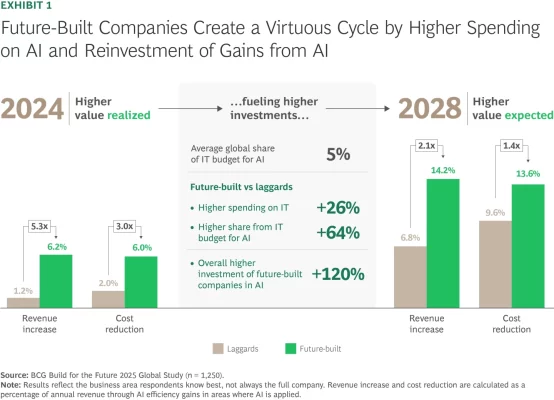
Image Source: BCG
The Paradox of AI
AI has transitioned from a niche technology to a mainstream business capability. Machine learning models, natural language processing tools, and generative AI tools are accessible to everyone, from startups to global enterprises. However, while technology has become more accessible, success depends on organisational readiness.
• Adoption without impact is common when AI projects lack clear strategic alignment.
• Scaling challenges occur because of fragmented data ecosystems and insufficient governance structures.
• Cultural resistance prevents AI from becoming a trusted decision-making partner.
In other words, the value gap is less about algorithms and more about people, processes, and scaling.
AI Leaders vs AI Laggards
The adoption gap can be understood by looking at two distinct groups:
AI Leaders
These organizations treat AI as a strategic asset and integrate it deeply into daily operations.
• Strategic Alignment: AI initiatives are linked to clear business outcomes.
• Enterprise Governance: Ethical use, data quality, and model transparency are enforced across departments.
• Scaled Infrastructure: Cloud-native, API-driven architectures enable rapid deployment and monitoring.
• Continuous Improvement: Models are retrained with fresh data and improved iteratively.
Example: A leading retailer uses AI not just for recommendation engines, but for inventory management, supply chain optimisation, and dynamic pricing—driving measurable revenue lift and customer satisfaction.
AI Laggards
These organisations run small pilots without a roadmap for scaling.
• Scattered Experiments: Projects exist in silos, disconnected from enterprise priorities.
• Weak Data Foundations: Inconsistent data formats, duplication, and inaccessible datasets cripple AI potential.
• Lack of C-Suite Engagement: AI remains a technical experiment, not a leadership priority.
• Low Workforce Trust: Employees resist adoption due to unclear benefits or accountability.
Example: A manufacturing firm uses AI for predictive maintenance in one plant but fails to roll it out company-wide due to governance and infrastructure gaps.
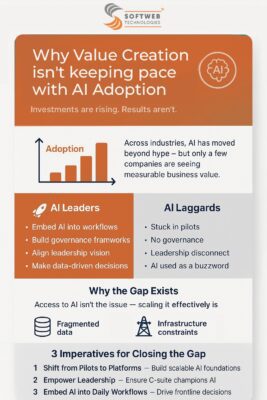
Root Causes of the AI Value Gap
Technical Barriers
• Disconnected data sources that prevent unified model training.
• Poor data quality resulting in biased or inaccurate outputs.
• Legacy IT systems incapable of supporting real-time AI integration.
Organizational Barriers
• No formal governance for model usage and ethics.
• Ineffective collaboration between business stakeholders and data scientists.
• Lack of metrics linking AI success to business impact.
Cultural Barriers
• Employee fear of automation replacing jobs.
• Resistance to changing decision-making processes.
• Limited investment in AI literacy and training.
Three Imperatives for Closing the AI Value Gap
1. Shift from Pilots to Platforms
Many organisations fall into the “pilot trap”—running small, siloed AI projects that demonstrate technical success but fail to scale enterprise-wide.
To unlock real value, the focus must shift from scattered experiments to a platform mindset.
Key Actions:
- Invest in unified AI platforms that consolidate data pipelines, model repositories, and deployment frameworks.
- Adopt API-driven architectures to enable seamless integration across departments and systems (through mobile apps).
- Build reusable AI components that reduce time-to-market for new projects and enhance standardisation.
Example:
A mining company replaced multiple ad-hoc forecasting tools with a centralised Mining AI platform, enabling consistent updates about shift-wise coal vs OB production, and machine availability across the mine site. The result? Unified insights, faster scaling, and reduced maintenance overhead.
2. Empower Leadership
AI transformation is not an IT initiative—it’s a strategic leadership mandate. Without strong executive sponsorship, AI projects risk losing direction, funding, and alignment with business goals.
Key Actions:
- Develop AI fluency for leadership teams so executives understand AI’s capabilities, risks, and opportunities.
- Define clear KPIs tied to business impact—such as cost savings, efficiency gains, and customer satisfaction.
- Allocate budgets for scaling, not just experimentation, ensuring long-term viability beyond pilot phases.
Example:
A leading bank’s CEO mandated that every new strategic initiative must include an AI component, embedding it into lending, fraud detection, and customer engagement processes. This top-down mandate ensured alignment and accountability across business units.
3. Embed AI in Daily Workflows
AI generates value only when it’s invisible yet indispensable—integrated into everyday systems where employees make decisions.
Key Actions:
- Thinking beyond ERP: Integrate AI into enterprise systems like CRM, ERP, and supply chain platforms, ensuring insights flow directly into daily operations.
- Embracing Intelligent Automation: Automate routine tasks to free human capacity for strategic decision-making and innovation.
- Feedback: Establish continuous feedback loops to refine model accuracy and adapt to changing realities.
Example:
A healthcare provider embedded AI directly into patient scheduling tools, allowing staff to make data-driven appointment adjustments without running separate analytics dashboards. AI became part of the workflow, not an external tool.
The Emerging Market Opportunity
Emerging economies face distinct challenges—fragmented infrastructure, limited AI talent, and slower digital maturity. Yet, these constraints also present a leapfrogging opportunity.
Without legacy systems to unlearn, these markets can adopt modern, cloud-native, and scalable AI foundations from day one.
Strategic Levers:
- Cloud-First Strategies: Skip on-premise limitations; adopt scalable, cost-efficient cloud AI platforms.
- Open-Source Ecosystems: Leverage open frameworks to reduce licensing costs and accelerate innovation.
- Public-Private Partnerships: Collaborate with universities, government programs, and tech hubs to co-create talent and infrastructure.
By investing in foundational AI capabilities early, emerging market organisations can bypass the slow modernisation curve seen in developed economies and establish competitive differentiation.
A 5-Step Roadmap to AI Value Creation
Define Strategic Outcomes – Begin with clear business goals and measurable targets.
Establish Governance – Build ethical, transparent, and accountable frameworks for AI usage.
Build Scalable Foundations – Invest in unified data architecture and AI platforms.
Integrate into Workflows – Embed AI outputs directly into daily decision-making tools.
Measure & Improve – Continuously monitor KPIs, refine models, and recalibrate strategies for sustained impact.
AI adoption is no longer a competitive differentiator—value creation is. Organisations that overcome technical, organisational, and cultural barriers while building scalable, governed, and workflow-integrated AI systems will lead in the next decade.
The winners will be those who move from pilots to enterprise platforms, empower leadership to champion AI, and embed AI invisibly into the way work gets done.
The gap between AI Leaders and AI Laggards will only widen—and now is the time to choose which side to be on.

How a Multi-Unit Tea Blender in Assam Eliminated Blend Traceability Gaps with PACE360 ERP
A leading tea blending company in Assam adopted PACE360 to unify procurement, blending, warehouse management, [...]
Jun

How a Packet Tea Manufacturer in West Bengal Scaled Distribution with PACE360 ERP
See how a leading yarn manufacturer moved beyond traditional procure-to-pay software to CVSS — Softweb’s [...]
Jun
The Future of Coal Supply Chain Management Through Automation & Innovation
See how a leading yarn manufacturer moved beyond traditional procure-to-pay software to CVSS — Softweb’s [...]
Jun

Beyond Procure-to-Pay: How a Leading Yarn Manufacturer Upgraded to CVSS and Cut Procurement Lead Time by 60%
See how a leading yarn manufacturer moved beyond traditional procure-to-pay software to CVSS — Softweb’s [...]
May
Beyond Fleet Tracking: Why Smart Iron Ore Mining Will Shape the Future of India’s Steel Industry
Discover how MiningPro by Softweb Technologies enables smarter, connected, and data-driven smart iron ore mining [...]
May

Blueeye in Kenya: Mara Coffee’s Digital Transformation Strategy for Multi-Farm Workforce Management
Mara Coffee, Kenya is transforming plantation workforce management through digital attendance tracking, productivity monitoring, payroll [...]
May

Why Cement Companies Need Smart Limestone Mining
Understand the nuances of Limestone Mining and How IoT, Fleet management and other Digital Mining [...]
May
Connected Workforce Platform for Open-Cast Mining: A Coal Mine IoT Case Study
Discover how Softweb Technologies deployed a real-time connected workforce IoT platform for open-cast coal mining [...]
May
