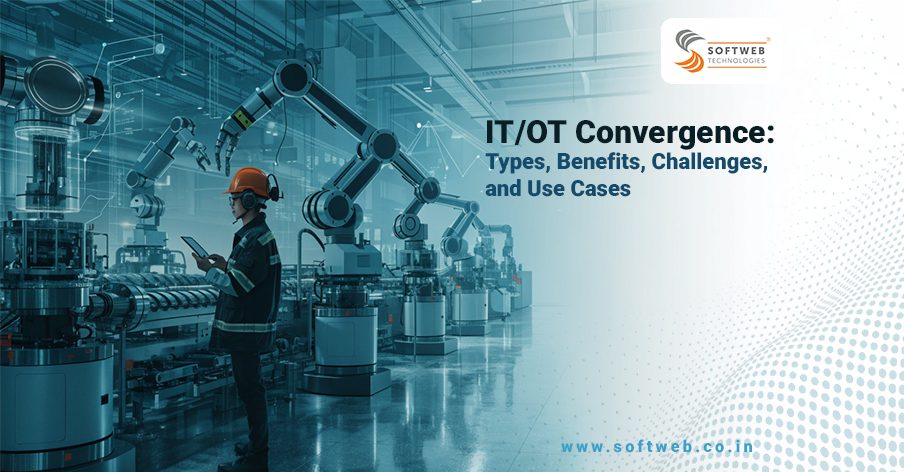
As industries continue their journey toward digital transformation, one concept has gained significant importance: IT/OT Convergence. Organisations today operate in two interconnected environments—the digital infrastructure that manages data and the physical systems that control industrial processes.
IT/OT Convergence refers to the integration of Information Technology (IT) systems—such as data platforms, analytics tools, and enterprise software—with Operational Technology (OT) systems that monitor and control physical equipment and industrial processes.
This integration allows organisations to connect machines, sensors, and operational assets with digital intelligence, enabling real-time monitoring, predictive insights, and improved operational efficiency.
While the benefits of convergence are substantial, implementing it also comes with certain challenges. Understanding the types, benefits, and practical use cases of IT/OT Convergence helps organisations successfully adopt this powerful transformation strategy.
Challenges of IT/OT Convergence
While the benefits of IT/OT Convergence are significant, organisations often face several challenges when integrating digital systems with industrial operations.
Cybersecurity Risks
Many traditional OT systems were originally designed to operate in isolated environments and were not built for network connectivity. When these systems become connected to IT networks, they may introduce security vulnerabilities if proper protection mechanisms are not implemented. Since OT infrastructure often supports critical operations, cybersecurity becomes a major priority during convergence.
Organisational and Cultural Gaps
IT and OT teams typically work with different priorities and expertise. IT focuses on data security and system performance, while OT emphasises operational reliability and safety. Aligning these teams and encouraging collaboration is essential for successful convergence.
Legacy System Integration
Many industrial environments rely on legacy machines that were never designed to communicate with modern digital platforms. Upgrading or retrofitting these systems with sensors and connectivity technologies can be complex, but it is often necessary to enable data integration.
Skills and Training
The convergence of IT and OT requires professionals who understand both industrial systems and digital technologies. Organisations often need to invest in training and skill development to bridge this gap.
Types of IT/OT Convergence
IT/OT convergence can take several forms depending on the organisation’s goals and technological maturity. Generally, it can be categorised into three main types.
1. Process Convergence
Process convergence focuses on aligning workflows and organisational structures between IT and OT teams. Since both departments must manage interconnected systems, they need coordinated processes for monitoring, data management, and incident response.
For example, a company may adapt its IT data governance policies to include operational data generated by industrial machines. This ensures that both IT and OT systems follow consistent security and data management practices.
2. Software and Data Convergence
Software and data convergence involves integrating operational data with enterprise software platforms such as analytics tools, ERP systems, or data management solutions.
In this model, operational information collected from sensors and industrial equipment is transmitted to IT systems where it can be analysed alongside business data. This integration allows organisations to gain deeper insights into production performance, asset utilisation, and operational efficiency.
Combining operational data with enterprise analytics enables better decision-making and supports advanced capabilities such as predictive maintenance and automated process optimisation.
3. Physical Convergence
Physical convergence focuses on integrating hardware components and industrial equipment with IT networks. This may involve installing IoT sensors or RFID tags, retrofitting machines with connectivity modules, or deploying new control systems that can communicate with enterprise platforms.
In many cases, organizations add aftermarket sensors or gateways to legacy equipment to enable data transmission without replacing the entire machine. Over time, these upgrades create a connected ecosystem where operational assets continuously share performance data with digital systems.
Benefits of IT/OT Convergence
When successfully implemented, IT/OT Convergence delivers significant operational and strategic advantages.
Improved Operational Visibility
Connecting industrial equipment with enterprise systems enables real-time monitoring of operations. Managers can access live data on machine performance, production rates, and operational conditions from anywhere in the world.
Stronger Cybersecurity Management
Instead of maintaining separate IT and OT security systems, convergence enables organisations to manage cybersecurity in a unified environment. This helps improve risk detection, vulnerability management, and security governance.
Reduced Operational Costs
Real-time data collection and predictive analytics help organisations identify inefficiencies, reduce maintenance costs, and minimise unexpected downtime.
Faster Innovation and Deployment
Integrated systems allow businesses to deploy new technologies and automation solutions more quickly. Digital insights can be applied directly to operational processes, accelerating innovation.
Regulatory Compliance
Many industries must adhere to strict regulatory standards. Converged systems improve traceability, reporting, and auditing capabilities, making compliance easier to maintain.
Enhanced Automation
IT/OT convergence allows operational equipment to respond dynamically to real-time data. Automation systems can adjust production rates, resource consumption, or machine settings based on demand and operational conditions.
Better Resource and Energy Management
With better visibility into operational data, organisations can optimise energy usage, reduce waste, and allocate resources more efficiently.
Unified Asset Management
When all operational and digital systems are connected, organisations can manage assets through a centralised platform, improving lifecycle management and maintenance planning.
Industry Use Cases of IT/OT Convergence
IT/OT convergence is transforming operations across a wide range of industries.
Manufacturing
In manufacturing environments, convergence allows production systems to connect with enterprise systems such as inventory management and demand forecasting tools. Manufacturers can adjust production levels based on real-time sales data, improving efficiency and reducing excess inventory.
Energy and Utilities
Energy providers use converged systems to remotely monitor infrastructure such as pipelines, power grids, and substations. Real-time operational insights help optimise maintenance schedules, prevent equipment failures, and improve energy distribution.
Transportation
Transportation companies rely heavily on asset management. By integrating IT systems with operational data from vehicles and infrastructure, organizations can track asset conditions, optimize routes, and improve safety.
Healthcare and Pharmaceuticals
In the healthcare sector, connected medical devices can share real-time patient data with hospital information systems. This integration enables faster diagnostics, better patient monitoring, and improved treatment outcomes. Pharmaceutical companies also use convergence to enhance manufacturing quality and regulatory compliance.
Retail
Retailers increasingly rely on IoT-enabled devices such as smart shelves, RFID tags, cameras, and point-of-sale systems. By integrating these operational technologies with IT analytics platforms, retailers can optimise inventory management, improve customer experience, and increase sales efficiency.
Mining
Mining is another sector where IT/OT Convergence is driving major transformation. Mining operations rely on heavy equipment, distributed assets, and complex logistics across large geographic areas.
By integrating operational technologies such as fleet management systems, sensors, and monitoring equipment with IT platforms, mining companies gain real-time visibility into equipment performance, fuel consumption, haulage efficiency, and asset health.
For example, connected sensors installed on mining trucks can transmit operational data to centralized analytics platforms. These systems can detect idle time, identify maintenance needs, and optimize dispatching operations. This leads to improved productivity, reduced operational costs, and safer working conditions.
Digital platforms powered by IT/OT convergence also enable predictive maintenance, automated reporting, and remote monitoring—critical capabilities for modern mining operations.
Conclusion
As industries embrace digital transformation, the integration of digital intelligence with physical operations is becoming increasingly essential. IT/OT Convergence bridges the gap between enterprise data systems and industrial equipment, enabling organisations to achieve greater visibility, efficiency, and operational control.
Although implementing convergence requires overcoming challenges related to security, organisational culture, and legacy systems, the long-term benefits far outweigh the difficulties.
From manufacturing and transportation to mining, healthcare, and retail, IT/OT convergence is reshaping how industries operate. Organisations that successfully integrate their IT and OT environments will be better positioned to leverage real-time insights, improve decision-making, and remain competitive in the rapidly evolving digital economy.
Facial Recognition and AI Video Analytics for Retail Stores: A Practical Guide
The modern-day retail stores, post-pandemic, have been facing new challenges in terms of bringing back [...]
Oct
How a Multi-Unit Tea Blender in Assam Eliminated Blend Traceability Gaps with PACE360 ERP
A leading tea blending company in Assam adopted PACE360 to unify procurement, blending, warehouse management, [...]
Jun
How a Packet Tea Manufacturer in West Bengal Scaled Distribution with PACE360 ERP
See how a leading yarn manufacturer moved beyond traditional procure-to-pay software to CVSS — Softweb’s [...]
Jun
The Future of Coal Supply Chain Management Through Automation & Innovation
See how a leading yarn manufacturer moved beyond traditional procure-to-pay software to CVSS — Softweb’s [...]
Jun
Beyond Procure-to-Pay: How a Leading Yarn Manufacturer Upgraded to CVSS and Cut Procurement Lead Time by 60%
See how a leading yarn manufacturer moved beyond traditional procure-to-pay software to CVSS — Softweb’s [...]
May
Beyond Fleet Tracking: Why Smart Iron Ore Mining Will Shape the Future of India’s Steel Industry
Discover how MiningPro by Softweb Technologies enables smarter, connected, and data-driven smart iron ore mining [...]
May

Blueeye in Kenya: Mara Coffee’s Digital Transformation Strategy for Multi-Farm Workforce Management
Mara Coffee, Kenya is transforming plantation workforce management through digital attendance tracking, productivity monitoring, payroll [...]
May
Why Cement Companies Need Smart Limestone Mining
Understand the nuances of Limestone Mining and How IoT, Fleet management and other Digital Mining [...]
May
