
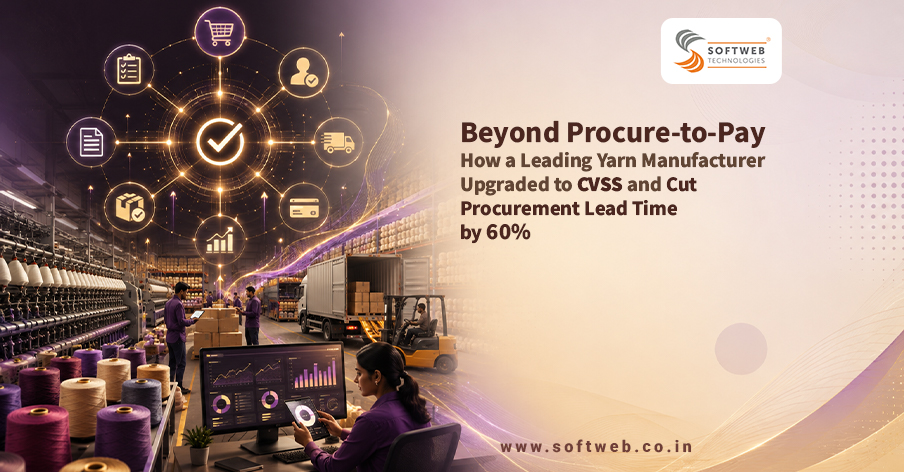
Most manufacturers are already using a procure-to-pay solution. But traditional P2P software stops at the purchase order — it doesn’t touch vendor dispatch, e-Challan generation, or real-time GRN automation. The result? Your procurement system ends exactly where your operational chaos begins.
For one of India’s leading yarn manufacturing companies, that gap had become a daily operational liability. Here is how they moved beyond conventional procure-to-pay software to CVSS — Customer Vendor Self Service — Softweb’s next-generation Procure-to-Pay platform built for manufacturers who need complete supply chain visibility, automated workflows, and a self-service vendor experience integrated with their ERP.
The Client
A large-scale yarn manufacturing company operating multiple production facilities across India, managing 500+ active SKUs and a vendor network of 60+ suppliers. With high-volume daily shop floor requisitions, a complex store’s operation, and growing supplier relationship management demands, their existing processes had grown far beyond what email chains and spreadsheets could handle. They needed a single platform to replace the patchwork of manual steps holding their procurement automation back.
Why Their Standard Procure-to-Pay Process Wasn’t Enough
The client had a basic procure-to-pay process in place — purchase requisitions were raised, approvals were sought, and purchase orders were issued. But the process collapsed at every step that came after. Vendors had no portal to view orders or submit dispatch documentation. Stores teams manually matched inward deliveries line by line against purchase orders. Approval chains lived in email inboxes with no escalation or visibility. The P2P system created a paper trail, but it didn’t create a connected operation.
What the team needed wasn’t a better P2P solution — they needed the layer that traditional procure-to-pay software was never designed to provide: real-time stock visibility at requisition, self-service vendor dispatch, and barcode-driven automated goods receipt.
The Four Pain Points Before CVSS
The Solution: CVSS — The Upgraded Procure-to-Pay Platform
CVSS is Softweb’s next-generation Procure-to-Pay platform that extends the traditional P2P foundation all the way from shop floor demand signals to vendor e-Challans and GRN confirmation. It was deployed as a cloud-hosted application with native Android access for floor teams and a dedicated web portal for vendors, integrated with the client’s existing ERP via bidirectional web service sync.
Step 1:
ERP-Integrated Requisitions with Live Stock Visibility
Department users raise material requisitions through the CVSS app by category — General, Maintenance, CWIP, Overhauling, or Production. Before submitting, they see live real-time stock balance, indent outstanding, and PO outstanding pulled directly from the ERP system. This single change eliminated 68% of duplicate and redundant purchase orders within six months.
Step 2:
Automated Multi-Level Approval Workflows
Requisitions move through a structured, rule-based multi-level approval workflow. The system automatically notifies the Department in charge via push notification and email. Average approval turnaround dropped from 2–3 days to under 4 hours. Out-of-stock items automatically trigger indent preparation and PO routing.
Step 3:
Barcode-Driven Store Issuance
Once approved, CVSS generates a printable barcode document. A single scan at the stores counter triggers automatic inventory deduction and issuance — replacing 45-minute manual processes with a sub-60-second operation. This is part of CVSS’s integrated inventory and GRN automation capability that goes well beyond what any standard P2P tool offers.
Step 4:
Vendor Self-Service Portal
The most transformative element. Vendors log into the CVSS vendor portal to view active purchase orders, allocate dispatch quantities, and generate barcode-enabled e-Challans digitally with vehicle number, invoice, and E-Way Bill. They track GRN confirmation and billing status in real time — without a single phone call to the client’s procurement team. Vendor onboarding required no ERP training; suppliers register, get activated, and operate independently through guided portal forms.
Step 5:
Automated Goods Receipt at the Factory Gate
The vendor’s e-Challan carries an embedded barcode. On delivery, store personnel scan it — the system instantly marks items as received in the inventory management system, stages them for inspection, and fires an automated GRN confirmation back to the vendor. Zero manual entry. Zero reconciliation errors.
The Results: What Moving Beyond P2P Actually Delivered
What’s Next: Closing the Full P2P Loop
Why CVSS Is More Than a Procure-to-Pay Solution

How a Multi-Unit Tea Blender in Assam Eliminated Blend Traceability Gaps with PACE360 ERP
A leading tea blending company in Assam adopted PACE360 to unify procurement, blending, warehouse management, [...]
Jun

How a Packet Tea Manufacturer in West Bengal Scaled Distribution with PACE360 ERP
See how a leading yarn manufacturer moved beyond traditional procure-to-pay software to CVSS — Softweb’s [...]
Jun

The Future of Coal Supply Chain Management Through Automation & Innovation
See how a leading yarn manufacturer moved beyond traditional procure-to-pay software to CVSS — Softweb’s [...]
Jun
Beyond Procure-to-Pay: How a Leading Yarn Manufacturer Upgraded to CVSS and Cut Procurement Lead Time by 60%
See how a leading yarn manufacturer moved beyond traditional procure-to-pay software to CVSS — Softweb’s [...]
May

Beyond Fleet Tracking: Why Smart Iron Ore Mining Will Shape the Future of India’s Steel Industry
Discover how MiningPro by Softweb Technologies enables smarter, connected, and data-driven smart iron ore mining [...]
May

Blueeye in Kenya: Mara Coffee’s Digital Transformation Strategy for Multi-Farm Workforce Management
Mara Coffee, Kenya is transforming plantation workforce management through digital attendance tracking, productivity monitoring, payroll [...]
May

Why Cement Companies Need Smart Limestone Mining
Understand the nuances of Limestone Mining and How IoT, Fleet management and other Digital Mining [...]
May

Connected Workforce Platform for Open-Cast Mining: A Coal Mine IoT Case Study
Discover how Softweb Technologies deployed a real-time connected workforce IoT platform for open-cast coal mining [...]
May
