
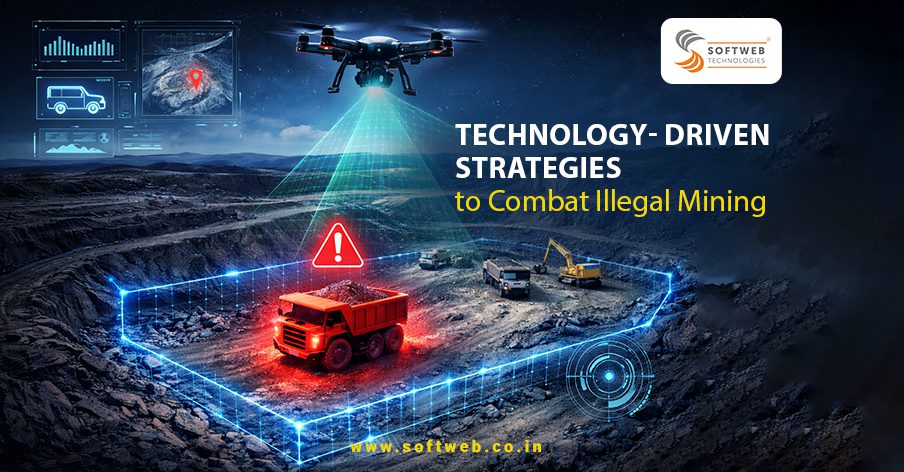
Illegal mining is one of the most serious threats to sustainable resource development worldwide. From riverbeds and forest reserves to lease boundary areas, illegal mining leads to environmental destruction, revenue loss, unsafe working conditions, and long-term ecological damage. Governments lose royalties, legitimate operators suffer reputational harm, and local communities face contaminated water, degraded land, and safety risks.
The key question today is: how to prevent illegal mining effectively and sustainably?
The answer lies in technology-driven surveillance, digital transparency, and real-time enforcement systems. Let us examine how illegal mining can be stopped using advanced tools and integrated digital platforms.
Satellite Monitoring: Detecting Illegal Mining from Space
Satellite imagery and remote sensing technologies have become foundational in preventing illegal mining.
Near Real-Time Surveillance
High-resolution satellite images (up to 3-meter resolution daily) allow authorities to monitor terrain changes, deforestation, excavation marks, and riverbed disturbances.
Change Detection and Boundary Monitoring
AI-powered change-detection software compares new satellite images with approved mining lease maps. AI in Mining helps in identifying excavation appears outside authorised boundaries, and automated alerts are generated for inspection teams.
Hyperspectral Imaging
This technology detects specific mineral signatures, helping regulators differentiate between legitimate extraction and illegal operations — even in remote forest regions.
When integrated into centralised dashboards, satellite intelligence enables authorities to move from reactive enforcement to proactive monitoring.
Drones: Ground-Level Verification and Evidence Collection
While satellites provide macro-level insights, drones offer high-resolution, localised verification.
Detailed Site Assessment
Drones can measure the exact dimensions of unauthorised pits and stockpiles.
Volumetric Analysis
3D mapping tools calculate the volume of illegally extracted material. This helps quantify financial loss and strengthens legal action.
Real-Time Action
Live drone feeds allow enforcement agencies to monitor suspicious activity instantly and deploy teams when required.
By combining drones with satellite alerts, regulators significantly reduce the time gap between detection and enforcement — a crucial factor in how illegal mining can be stopped effectively.
Artificial Intelligence: Smarter Detection and Predictive Enforcement
Artificial Intelligence (AI) plays a central role in preventing illegal mining at scale.
AI systems analyse massive datasets from satellites, drones, transport permits, and inspection reports to detect anomalies such as:
- Sudden vegetation loss
- Water discolouration near mining zones
- Emergence of new access roads
- Unusual truck movement patterns
Automated Image Classification
Machine learning models differentiate between legal and illegal sites, reducing manual verification efforts.
Predictive Analytics
AI can forecast illegal mining hotspots by studying historical data, socioeconomic patterns, and terrain vulnerability. This enables proactive enforcement rather than waiting for violations to occur.
Intelligent Command Centres
When AI feeds into centralised control rooms, authorities gain a unified, real-time view of mining activities across districts or states.
IoT, GPS, RFID & WIM: Controlling Illegal Mineral Transportation
Stopping illegal mining is not just about excavation — transportation is a critical loophole.
GPS Vehicle Tracking
Trucks carrying minerals are fitted with AIS-140 compliant GPS devices. Alerts are triggered if vehicles deviate from approved routes or enter unauthorised areas.
RFID-Based Check Gates
RFID provides real-time visibility of assets, inventory and operations. RFID tags on authorised trucks interact with automated boom barriers. Unauthorised vehicles are denied entry into mining zones.
Weigh-In-Motion (WIM) Systems
WIM sensors embedded in roads measure vehicle weight while in motion. Overloaded trucks often indicate illegally extracted or unregistered material.
These technologies ensure traceability from pit to destination, reducing the black-market circulation of minerals.
Digital Permits, E-Challans & Citizen Engagement
Digital governance platforms are essential in how illegal mining can be stopped systematically.
E-Challans & QR-Based Permits
Electronic transport permits ensure that only legally mined, taxed minerals are transported. QR codes or blockchain-backed documentation create tamper-proof traceability.
Citizen Reporting Platforms
Mobile apps allow citizens to report suspicious activity with geo-tagged photos and descriptions. This creates community-driven vigilance.
Integrated Command Centres
Data from satellites, drones, RFID gates, WIM sensors, and e-permit systems converge into centralised control rooms for coordinated action.
Real-World Impact
Uttar Pradesh, India
The integration of drones, AI systems, and WIM sensors led to the blacklisting of over 21,000 vehicles and the stronger regulation of mining activities.
Meghalaya, India
Illegal mining in Meghalaya highlighted the urgent need for stronger technological oversight and structured regulatory mechanisms.
Ghana
The government has deployed AI-enabled GPS trackers on excavators and uses drone surveillance to monitor forest reserves vulnerable to illegal mining.
Government Initiatives and Regulatory Strengthening
Governments are increasingly adopting:
- GIS-based lease boundary surveillance
- Transparent e-auction processes
- Satellite alert systems for irregularities
- Sustainable mining guidelines
- Increased private participation in mineral exploration
Digital mineral administration systems such as e-Khanij have enhanced transparency in concession management and mineral movement tracking.
These structured frameworks, backed by technology, create a strong deterrence.
Integrated Digital Platforms: The Way Forward
Isolated tools can detect illegal mining, but integrated platforms deliver real impact.
A unified digital mining surveillance ecosystem — combining satellite data, AI analytics, IoT sensors, fleet tracking, digital permits, and command centre dashboards — creates complete visibility across the mining value chain.
Advanced mine digitisation platforms like MiningPro, for instance, are designed to integrate operational monitoring, transport surveillance, analytics, and compliance tracking into a single digital ecosystem. When such systems are aligned with regulatory frameworks, they help authorities and mining companies ensure transparency, optimise monitoring, and reduce operational blind spots that illegal miners often exploit.
Conclusion: How to Prevent Illegal Mining in the Digital Era
Illegal mining thrives where monitoring is weak, transport is untracked, and enforcement is delayed.
To effectively answer the question of how to prevent illegal mining, authorities must:
- Monitor land through satellite and drone surveillance.
- Use AI for anomaly detection and predictive hotspot analysis.
- Implement GPS, RFID, and WIM systems to track mineral transport.
- Deploy digital permits and centralised command centres for real-time decision-making.
- Encourage citizen participation for local vigilance.
When combined into a unified digital ecosystem, these technologies significantly reduce unauthorised extraction and create accountability across the mining supply chain.
In the modern mining landscape, technology is not optional — it is the most powerful tool in ensuring that illegal mining is detected early, stopped quickly, and prevented sustainably.

How a Multi-Unit Tea Blender in Assam Eliminated Blend Traceability Gaps with PACE360 ERP
A leading tea blending company in Assam adopted PACE360 to unify procurement, blending, warehouse management, [...]
Jun

How a Packet Tea Manufacturer in West Bengal Scaled Distribution with PACE360 ERP
See how a leading yarn manufacturer moved beyond traditional procure-to-pay software to CVSS — Softweb’s [...]
Jun

The Future of Coal Supply Chain Management Through Automation & Innovation
See how a leading yarn manufacturer moved beyond traditional procure-to-pay software to CVSS — Softweb’s [...]
Jun

Beyond Procure-to-Pay: How a Leading Yarn Manufacturer Upgraded to CVSS and Cut Procurement Lead Time by 60%
See how a leading yarn manufacturer moved beyond traditional procure-to-pay software to CVSS — Softweb’s [...]
May

Beyond Fleet Tracking: Why Smart Iron Ore Mining Will Shape the Future of India’s Steel Industry
Discover how MiningPro by Softweb Technologies enables smarter, connected, and data-driven smart iron ore mining [...]
May

Blueeye in Kenya: Mara Coffee’s Digital Transformation Strategy for Multi-Farm Workforce Management
Mara Coffee, Kenya is transforming plantation workforce management through digital attendance tracking, productivity monitoring, payroll [...]
May

Why Cement Companies Need Smart Limestone Mining
Understand the nuances of Limestone Mining and How IoT, Fleet management and other Digital Mining [...]
May

Connected Workforce Platform for Open-Cast Mining: A Coal Mine IoT Case Study
Discover how Softweb Technologies deployed a real-time connected workforce IoT platform for open-cast coal mining [...]
May
