
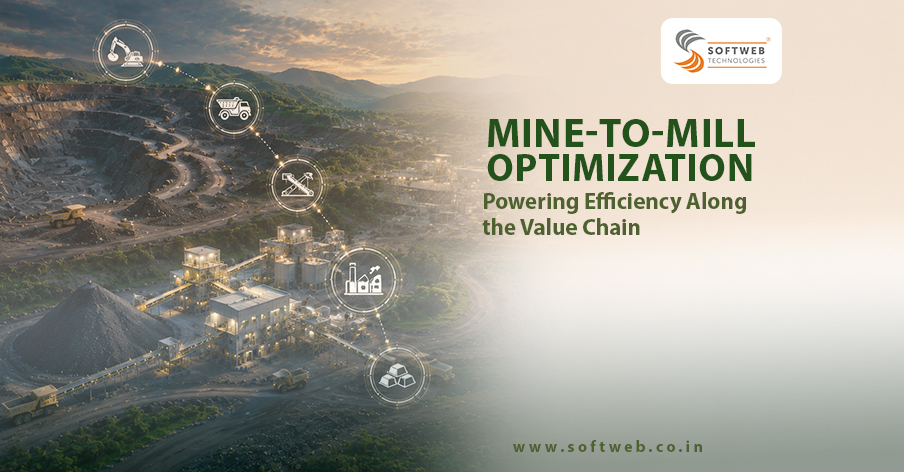
Mining operations in the modern era are no longer stand-alone segments of excavation and processing—they are integrated value chains in which every link can influence the next. Mine to mill optimization is a contemporary, systems-based approach that integrates these phases to realize greater throughput, lower energy consumption, and substantial cost savings.
This integrated approach brings mining and processing operations into alignment to maximize value, enhance efficiency, and maintain consistent high-quality feed from the pit to the plant.
What Is Mine-to-Mill Optimization?
Mine-to-mill optimization is a holistic process that aims to increase productivity by optimizing and analyzing the whole size-reduction chain—from blasting in the pit to crushing, grinding, and milling in the plant.
Unlike traditional models that treat mining and processing as separate entities, this approach connects the two, recognising that upstream changes—particularly in blasting—can significantly influence downstream performance in crushing and grinding circuits.
A well-executed mine-to-mill initiative typically follows four key phases:
- Scoping Study – Reviewing current practices and identifying improvement areas.
- Analysis – Surveying processes from blasting to screening, supported by data collection and rock characterization.
- Optimisation – Employing modelling software (such as JKSimBlast and JKSimMet) to model situations and optimise operations.
- Implementation – Implementing optimal strategies in actual operations and monitoring the gains.
Why Mine-to-Mill Matters: From Fragmentation to Throughput
Blasting is the initial opportunity for comminution—the reduction of rock size—and it’s less costly and less energy-intensive than downstream grinding or crushing. But the real value of improved blasting is its effect on mill performance.
- By enhancing blast fragmentation:
- Feed is more consistent.
- Fine particles (less than 12mm) are more common, eliminating mill bottlenecks.
- Throughput can be increased up to 30%.
- Processing costs are minimised substantially.
In addition, mines using advanced blasting methods seldom revert to cost-saved, low-energy blasts. Productivity increases, material handling simplicity, and consistent feed quality provide tangible value throughout the operation.
Quantifying the Gains
Evidence from studies indicates that mine-to-mill optimization can lead to:
10–20% productivity gains with minimal changes.
Substantial savings in mill operating costs, usually 7–10 times more than any additional blast cost.
Improved performance consistency, resulting in improved planning, less equipment wear, and higher downstream recovery rates.
But only if the optimisation process is data-driven and progressively improved.
Digital Transformation and Mine-to-Mill
In the age of Mining 4.0, digitalisation is allowing a heightened integration and transparency across mine-to-mill processes. With the help of sophisticated data modelling, simulation software, and process analysis, operations can now:
- Model the effect of blast designs on subsequent circuits.
- Tune fragmentation profiles for various ore domains.
- Track process variables in real time.
- Dynamically align mill settings with ore conditions.
Digital transformation not only closes the gap between mine and mill but also infuses flexibility and intelligence into the operation.
How IoT Enhances Mine-to-Mill Optimization
The Internet of Things (IoT) is becoming a game-changer in facilitating real-time, data-driven decision-making throughout the mine-to-mill continuum.
Here’s how IoT adds value:
Sensors on drilling and blasting equipment can offer feedback on blast performance, explosive loading, and vibration control.
Real-time fragmentation monitoring via vision-based sensors or drone surveying assists in evaluating if the blast has produced the required particle size distribution.
Condition monitoring sensors placed on crushers and mills assist in identifying inefficiency or equipment stress due to feed variability.
Edge computing and wireless data acquisition facilitate ore properties measured at the mine face to enable processing plants to make instant adjustments.
By connecting a network of intelligent devices across the mining value chain, IoT ensures insights flow smoothly from pit to plant, enabling dynamic optimisation. Additionally, these data are analysed by Artificial Intelligence (AI) in mining operations, delivering key insights and predictive control.
Challenges and Considerations
Mine-to-mill optimisation contains enormous potential but relies on:
Accurate rock characterisation and data collection.
Coordination between the mining and processing departments.
Being committed to constant improvement and continuous performance benchmarking.
Being open to investing in simulation tools and digital infrastructure.
We must deal with the mine and the mill as partners. The mine has to provide a feed that is appropriate for the needs of the mill, and the mill has to be prepared to adjust and optimise depending on what is being supplied by the mine.
Mine-to-mill optimisation is more than a technical improvement—it’s a change in mindset toward integration, communication, and common purposes in mining operations. As the industry continues toward Mining 4.0 with its adoption of digital tools and IoT-based intelligence, this trend becomes not merely desirable, but imperative.
Early adopters to mine-to-mill optimisation across operations are already seeing enhanced efficiency, lower cost, and an environmentally friendlier future ahead.
The process from rock to finished product is no longer distinct steps—it’s a seamless, smart flow of value.
